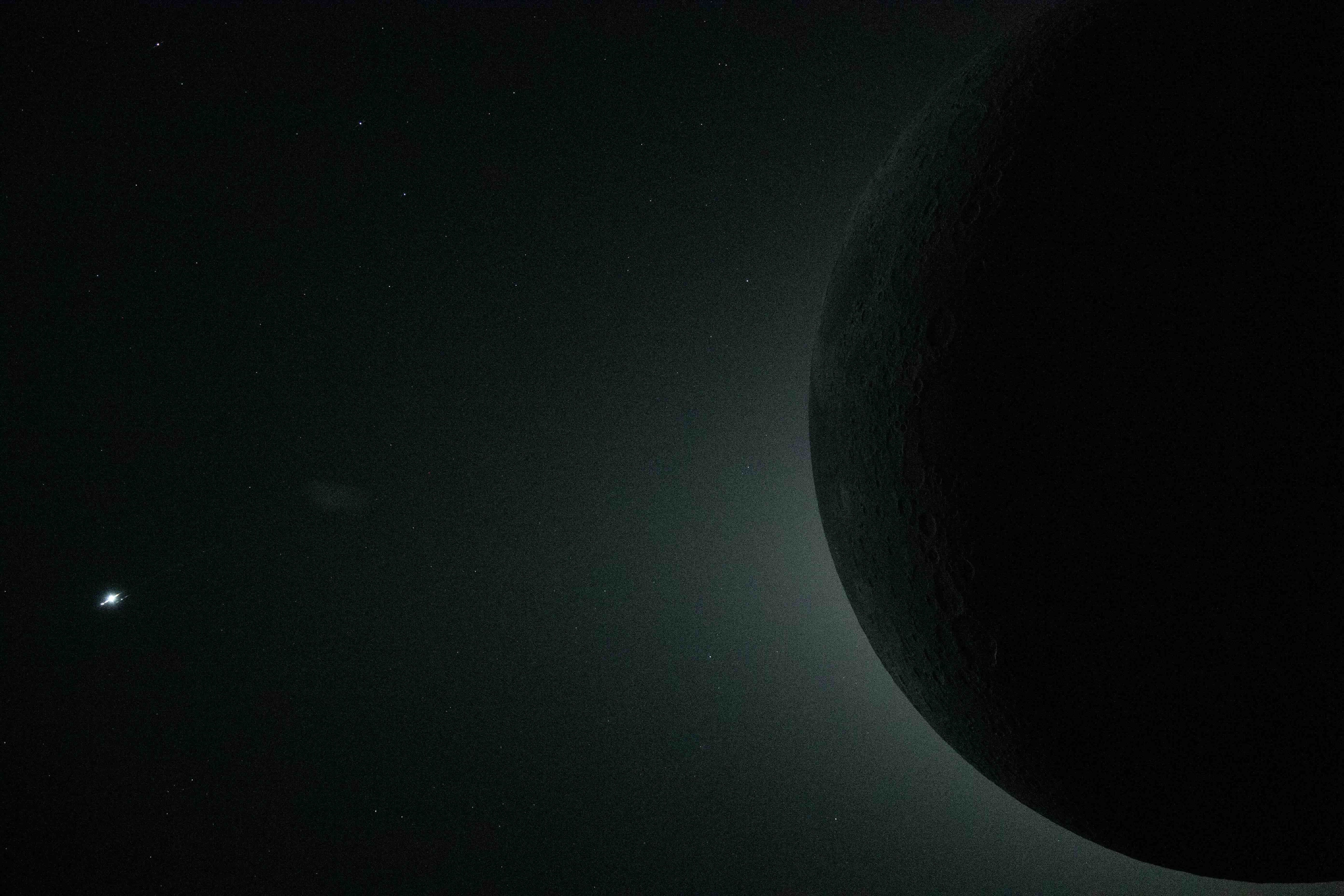
A photo of the dark side of the moon from the Artemis II mission. Source: NASA
This post is a response to A proposal for Great Power Races by a friend of mine, Luke Eure. In it, he proposes a framework for moving humanity forward and avoiding a great power war (i.e. World War III).
Core to his argument is the idea that nothing unites a people like a shared enemy. History is littered with examples, but the Roman Empire offers a cautionary tale: whenever Rome wasn't waging wars of conquest on its neighbors, it turned inward and fought civil wars. Without an external challenge a society's energy doesn't disappear, it finds an outlet.
In the nuclear age however, the notion of war is much more existential than it used to be. If we enter into a hot war with another superpower, it's likely game-over for humanity. If we believe competition is healthy for a society, but literal fighting is too destructive, what else can we do?
Luke argues that we must find a great power race to unite us. A great power race, he asserts, must:
I agree wholeheartedly with Mr. Eure. But I would argue there is only one worthy super-project. It should be a project more ambitious than any other, a project unmatched in its grandeur, and a project which appeals to our deepest human desire to explore. It needs to be so large and all-encompassing as to mobilize an entire population. We must go to Mars.
Going to Mars checks all of Luke's boxes. It's ambitious, it's cool, and it is verifiable. Either you put life on Mars or you didn't. But above all else, it is important.
We have no idea how common complex life is throughout the universe. It is entirely possible the great-filter is the development of complex life. If that is the case, we have an obligation to preserve and grow life as much as possible. I have many friends who care greatly for nature, who love all of the wonderful plants and animals that inhabit our beautiful home of Earth. These friends often see technological development as a threat to these creatures. I would agree with them generally, but it does not have to be this way. We can use improvements to technology to further protect life on this earth.
In particular, existential risks to humans also pose a major risk to earth's biodiversity. A nuclear war or a meteor collision could completely wipe out our biodiversity. If we could find a way to one day make Mars habitable for us Earthlings, we would be able to ensure life continues, even in the event of a catastrophe. Imagine a solar system or even a galaxy, teeming with beetles, deer, dogs, magnolias, and mushrooms!
Long term survival of life generally should be our highest priority. Extension, preservation, and improvement of specific lives are secondary to the continued existence of life generally.
One argument against Mars is that there are easier ways to achieve the preservation of life in the event of a catastrophe. One could imagine building enormous bunkers of some kind here on Earth. I would argue that those are not sufficiently protected from catastrophe on Earth. If things go belly-up on the surface, the first thing survivors would do is raid the bunkers. And in the case of a super-virus, it would only be a matter of time before the virus also ends up in the bunker. The threat to the auxiliary-life-community is significantly lower with a Mars colony than with a bunker.
Another potential idea is some sort of a space ark similar to the one seen in Wall-E. Self-sustaining spaceships with colonies of humans. I would argue this would be even more difficult and more brittle than putting a colony on Mars. Getting to Mars is hard, establishing a Mars colony would be really hard, but creating a self-sustaining spaceship which carries Earth's life would be even harder. There's a saying in the aerospace industry which is something along the lines of "everything is harder in space". Every difficulty of setting up a colony on Mars is even harder if you have to do it on a self-sustaining spaceship. And it's debatable, but I'm of the opinion that a space ark is less cool than a Mars colony.
You might argue life redundancy is too big of a problem, and that we would be better served by addressing a problem closer to home.
Why not put an end to global poverty? This is not a technological problem but a political problem. There is no need for anyone on Earth to be without basic necessities, but, alas, many still live below the poverty line. If you can figure out a way to convince the politicians of the leading nations of the world to focus on this issue, let me know, because that also means that you've achieved world peace and the end of the human condition.
Why not cure Alzheimers or Cancer? I would argue this doesn't engage a large enough subset of the population. Operation Warp Speed was an incredible achievement, but was anyone you know involved in it? Our super-project needs to be sufficiently large, such that many different sectors of the economy (not just bio-tech) can be employed by it. I think about projects like the Tennessee Valley Authority, where working class people were given good jobs to build infrastructure. Working men benefitted in the present, everyone in the future benefitted from improved infrastructure. Win-Win.
In comparison, a Mars project would require the scaling up of many different industries; we need engineers, biologists, and doctors, but we also need people to build the spaceships, and to build the infrastructure to launch spaceships, and we need people to work in the factories for all of the components of this project. Going to Mars is a project which would require all sectors of the economy.
A Mars project straddles the border between achievable and ambitious. It's ambitious enough to engage an entire population (unlike curing Cancer), but still achievable (unlike solving global poverty).
In Luke's post, he says a good heuristic for a great power race would be:
If Trump can tweet about the race, and even people who don’t like Trump would say “yeah it would be cool if we did that”, then it’s a good race.
This is one area Luke and I disagree. I think the ideal great power competition needs to be ambitious enough to draw serious criticism. If people don't think you're crazy, you aren't thinking big enough. If the project isn't sufficiently large, it won't engage a large enough swath of the population, and you don't get the benefit of uniting a people towards a common goal.
A project of this scale by its nature cannot stand on its own merit. It's far too difficult of a problem to progress organically, and would require a leader of considerable skill to navigate. We need a JFK type figure. JFK was not universally loved, but he didn't have to be. He was able to convince the US to embark on a seemingly impossible quest to the moon. If JFK could mobilize the US to get us to the moon in the 1960s, a good leader could get us to Mars in the 2030s.
The short-term benefits of a great power competition scale with the size of the project: national unification, productive jobs for population, and an outlet for international competitive urges. It's necessary for the project to be "crazy" for it to be useful.
I would challenge the reader to think of a project more ambitious than going to Mars. Think of a project which involves a wider swath of the population. Think of a project which captures the imagination of more people.
Those that say it is not possible, or too hard, are thinking way too small. Humans got to the moon using computers less powerful than a modern pocket calculator. Humans populated the islands of the pacific, crossing thousands of miles of open ocean, in boats not much better than canoes. Humans built the great pyramids of Egypt thousands of years before the birth of Christ.
We can and must go to Mars. We just need a leader bold enough to say we can. We need a leader itching to fight against the entropy of the universe, and not each other.